|
|
Rear wall, rear view.
-
Note the bottom mounted source connectors to insure
shortest possible signal path. Power inlet and switch to the left. (94k)
Ready for tests and measurements…
-
The rubber suspended 1kVA 2 x 18 V transformer, the
resistor heatsinks and the 147.000uF capacitor collection requires quite
a lot of space. If you live in a house that contains women, don't let go
at this point. Believe me, I've tried it, and they don't like amplifiers
looking like this. When I look at the state of my workbench, I realize
that I must have been quite enthusiastic at this stage! (115k)
Here's a smart detail:
-
The blue LED on the front plate is connected to the
power supply with a standard RCA connector so that the front plate can
be removed easily. The main fuse and the reference voltage adjustment for
the DC protection circuits are accessible from here. Note the huge black
industrial 3,3 mH inductors close to the right resistor heatsinks. The
small o-core inductors in the front also helps smoothing the DC a bit.
On top of the transformer, you can see the rectifier heatsink with the
soft-start circuit on top. Since both rectifier and transformer is rubber
suspended, no noisy vibrations will be transferred to the cabinet through
the heavy gauge solid core wires from the secondary windings.(101k)
The finished amplifier.
-
To get an idea of the size, compare it to my 28" TV-set.
The front plate is made from 15 mm oiled slate, equipped with one blue
LED only. Overall dimensions 480 (w) x 365 (d) x 280 (h) mm, final weight
43 kg, output power 2 x 10 W, total heat dissipation 475 W. Luckily, electricity
is quite cheap in Norway where I live.
In my system, the SOZ has a very natural and clear
high- and midrange, but the bass turns out a bit "boomy" in my opinion,
probably due to the low (if any) damping factor. However, A friend of mine
who recently bought the amplifier says it is one of the best performing
amplifier he has ever heard. He has got a pair of high efficient Avantgarde
Duo horn speakers. As he says, the only drawback is that he can wear nothing
but his boxers when listening to music in his well-isolated attic. My sandwich
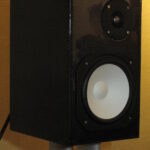
cabinet loudspeakers shown on the picture are also quite extreme, weighing
97 kg each. The side, top, bottom and rear walls are made from MDF, sand,
asphalt, aluminum and copper, baffle is made from compact MDF. The stands
are made from aluminum tubes and concrete. Seas Excel and Focal drivers
are used. As they sound quite well, maybe I will put this speaker project
on the www as well some day.
(69k)
|