Distilling
the design goals and concepts for the oneZ led to a configuration
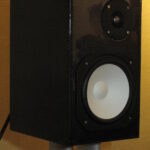
featuring a mini monitor reflex enclosure of birch plywood loaded with a single full range
driver. The architectural elements are thus enclosure type, driver selection, materials choice, and style. The following discussion
examines each in turn..
the enclosure
An aesthetic of simplicity is the
constant touchstone for the
oneZ. Simplicity also extends to issues such as size and ease of
construction. There is a place for large and complex enclosures in the
audio arts, the oneZ is not that place. This aesthetic of simplicity ruled out the horn
loaded and tuned quarter wave boxes so popular with those bleeding on
the cutting edge of the single driver wide range speaker art. Vented vs. sealed box was never really an
issue given the goal of high efficiency and the parameters of likely
drivers. Thus a vented mini
monitor was quickly selected as the most likely candidate. When the first
oneZ prototype was fired up it was immediately obvious this
configuration is capable of overachieving results. The task then became
refining the details while extending the performance envelope.
A great deal of thought, design, prototyping, and redesign went into
the details of the oneZ box design. Mechanical performance, manufacturability, structural integrity, ease of assembly,
and style all formed an interactive system which drove the design
through eight major revisions. We wanted a design the neophyte could
assemble on a kitchen table yet looked like an experienced cabinet
maker had lavished his skills on the joinery. Simple yet not too simple
displaying the knowledge of just how critical a component sub-system
the speaker
box is now recognized to be.
A major design issue for high-end speakers is how to deal with unwanted
vibration in the enclosure. Reaction forces from the driver as it works
against the baffle surface and internal pressures cause vibration in
all speaker boxes. It is now widely recognized that while these
vibrations are relatively small the large surface area of the enclosure
walls can result in audible coloration of the sound. The
popular solution for this is to use thicker heavier walls. Taken to a
sufficient extreme this can be effective, however there are costs.
Costs in dollars for more material and then more dollars to ship the
resulting weight. Costs in design as the thick walls expand exterior
dimensions and/or reduce interior volume. And costs in tone quality
when thick heavy construction is allowed to impart a thick leaden
quality to the reproduction.
As
the First Law of Thermodynamics informs us energy
can not be created nor destroyed. Therefore damping materials work by
converting mechanical energy (in this case vibrations in the speaker
enclosure walls) into heat energy. During this process the walls still
vibrate, when they are heavy this energy excites lower frequency
resonance modes. Because of the high mass per unit of volume involved
the enclosure tends to store energy and release it over a longer period
of time. The lower frequency vibrations smeared out over time
contribute to a thickening of the reproduced sound. As always in
engineering there are alternative techniques available to address any
issue. An alternative technique for enclosures is to make them stiff
and light. The modern standard bearer for stiff and light hi-fi speaker
enclosures was the Celestion SL600. With an enclosure made of aerospace
structural honeycomb the SL600 epitomized the 'stiff & light' technique.
Basically the 'stiff &
light' design technique
accepts that in real
world materials vibration is a fact of life and aims to manage the
amplitude, frequency and resulting effects. When a structure is stiff
and light its natural resonance modes will occur at higher frequencies
compared to the same structure constructed from lossy heavy materials.
The 'stiff & light'
speaker enclosure takes advantage of the fact that on average music has
most of its power at lower frequencies and less at middle to higher
frequencies. Music instruments and styles have evolved this
characteristic to match the lower sensitivity of human hearing at low
frequencies. Thus the 'stiff
& light' technique takes
its enclosure out of harms way by placing its resonance modes higher in
frequency where there is less energy to excite it. When the system is
viewed in the time domain there are additional benefits to 'stiff & light'. Lighter structures store less energy and
release it quicker compared to heavyweights. Given music's transient
nature and resulting high peak to average power ratios the 'stiff & light' technique will result in less time smear
compared to the longer ringing times of heavier enclosures. The oneZ
design takes the 'stiff & light' technique and allies it with an energy
trap (see materials section
below) built into the front baffle. The energy trap attenuates the
unwanted reaction forces generated by the driver before they can reach
the rest of the enclosure. Remaining energy reflecting back into the
baffle will be further attenuated by another trip through the energy
trap before it reaches the driver/baffle interface. This
increases the mechanical signal to noise ratio of the driver
mounting area of the baffle. A quieter more stable driver mount
increases micro dynamics further revealing fine musical detail.
the driver
Selection criteria for the oneZ's driver called for balancing multiple
criteria including musicality,
electromechanical performance,
reliability, efficiency, bandwidth, availability, and cost. Severest
and most unusual among these is the desire to cover eight or nine
octaves of the musical spectrum using a single driver with at least 90
dB/W/M efficiency. A crowd of contenders is thus immediately reduced to
a field on one, Fostex. Worthy units from both the obscure and well
know manufacturers in Europe, Japan, UK, USA, and Asia were ruled out
on
grounds of cost, availability, questionable reliability, and low efficiency. That Fostex would win out is
hardly surprising given they bring the following long list of pluses:
Large multi-national company.
Professional audio division
adds stability and cash resources.
Located in Japan, the hotbed for both DIY audio and
single driver full range speaker enthusiasts.
Years of experience
manufacturing wide range
speaker drivers.
The broadest and deepest range
of high performance wide range speaker drivers of any manufacturer in
the world.
The breath of Fostex's range of hi-fi
full range speaker
drivers became apparent as the driver for oneZ was selected.
Flexibility and upgrade paths are desirable characteristics for any
hi-fi
component so it was great to discover not one but four Fostex drivers in the
100mm/4" class which will match the oneZ box.
FE107E
- High performance shielded 80 Hz - 20 kHz 90 dB/W/M driver featuring
ES banana pulp cone and new center cap design for extended high
frequency response.
FE103E
- Unshielded version of FE107E. Both FE103E and FE107E are very
reasonability priced.
F120A
- Ultra-fi Alnico magnet 65 Hz - 20 kHz 89 dB/W/M driver. Alnico for the final
stop on the journey to musical bliss. Expensive.
FW108N
- Wide range mid-woofer 55 Hz
- 10 kHz 86 dB/W/M driver
features hybrid pulp cone and 1.9mm Xmax for high output. Moderately
expensive.
With multiple driver options oneZ
becomes not just a hi-fi speaker but a system which can be configured
in a variety of ways to better match individual needs and tastes. The
configuration can also be upgraded or re-engineered as upstream
components evolve over time. One can easily see three major
configurations depending on which driver is loaded:
FE103/7E
- overachieving price/performance ratio with amazing direct coupled
tracking of the input's every nuance.
F120A
- the ultimate mini monitor for the owner of an advanced triode
amplifier as nothing brings out music's textures and emotional impact
like Alnico.
FW108N
- high output bass/mid system for use with super tweeters and beefier
amplifiers mixing a large measure of the coherence of a full range
driver with the output capabilities of more mainstream large Xmax
drivers.
The FE103/7E deserves further
discussion. The biggest problems this driver has are:
its too inexpensive for audio snobs to take seriously,
it's never occurred to many audiophiles that a 4" driver could
be their ideal solution.
In Japan where audiophiles talk
less and build more the FE103E and FE107E have what at times appears to
be a cult following (Google "FE103E jp" and "FE107E" and see for
yourself). This had not really sunk in when I hooked up my first pair
of FE107Es. The numbers looked good and they were not busting the oneZ
project parts budget. It was expected they would sound good. The actual
sound this unassuming little driver delivers far exceeds the
expectation of 'good'. The first attribute is a transparent directness
which reveals both a wealth of musical detail and texture as well as
the rhythmic pace and structure of the music. Then along comes some
well recorded high frequencies and one is presented with the most
delicate, almost ethereal, reproduction of treble. What does this thing
think it is a 4 inch tweeter? Bass just jumps along and boogies in
lockstep with the music and while hardly sub sonic in depth or room
pressurizing in amplitude bass is so tuneful with the FE103/7E that
part of the music is well covered. Imaging is outstanding with
directional cues effortlessly portrayed in a Cinemascope wide arc
extending well beyond the speaker pair outer boundaries.
Attempting to describe sound in words we almost invariably break it
down into "the bass is this, and the mids are like that, and the highs
are.....etc". Such analytic dissections largely miss the point of what
happens when an FE107E is combined with an advanced enclosure and
energized with the right amp. The result is all about a wholeness, a
completeness throughout the range, and speaking with a single unified
voice. Time
and again one is struck by how direct and transparent yet utterly
natural the music sounds.
materials
Have you ever seen a violin made out of MDF?
Conceptually
and literally what
an object is made out of in large measure determines its basic
characteristics. When engineers are tasked with advancing the state of
the art in their designs they often turn to more advanced materials.
Titanium replaces steel and carbon fiber replaces aluminum the more
advanced materials extending the device's performance envelope. When
artists and craftsmen wish to elevate the objects they create the first
order of business is selecting the materials
most apropos to the work. Likewise in the
artful craft of engineering hi-fi loudspeakers the choice of materials
will have effects propagating throughout the design. The oneZ
project aesthetics and engineering both aspired to an
achievement beyond the typical. This calls for the use of atypical
materials. The improbable pairing for this role are birch plywood and sand.
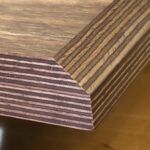
Birch-ply is a special high grade plywood made with thin layers of wood
veneer and without the internal voids typical of
construction grade plywood. The retention of wood's natural fibrous
structure within the layers of veneer forming birch-ply make it very
strong. With the material's strength coming from these fibers a large
percentage of heavy glues and fillers is unnecessary allowing birch-ply
to be light yet strong. Thus it matches well with the stiff & light criteria used in the oneZ enclosure
design. On the aesthetic side
of the design equation birch-ply has a smooth real wood grained surface
and unique thin layered end which finds it often selected by modern
furniture designers and art craft object artisans.
Sand is another atypical material when considering the
majority of
hi-fi speaker designs. Commercially it is just out of the question to
ship devices loaded with heavy sand. And it is a marketing disaster
with all the extra complexity and material cost required to use sand
hidden inside the enclosure. That is a shame because as anyone who has
ever tried to run across a soft beach can testify sand is unparalleled
in
its ability to absorb and damp out energy. For years I had read of
early hi-fi pioneers who built speaker enclosures with double walled sand filled construction. This was filed away with
other audio gizmo trivia. Then in a previous professional life working
in the oil exploration industry the fact that sound waves used
for seismic exploration would not propagate through areas of sand
peaked interest in this plentiful material. If a dynamite charge
or 60,000 pound vibrator cannot force seismic sound waves through sand
what chance does a little speaker driver have?
Why is sand such an
ideal material when the task is sound or vibration attenuation?
Remember the First Law of
Thermodynamics which states energy cannot be destroyed only propagated
or converted into another form. Sound travels through air and solids as
a wave form propagating from
molecule to molecule. In a gas the molecules are light and undamped allowing
the energy to jump from molecule
to molecule with little loss.
In solids the molecules are
certainly heavier compared to a gas yet they are so tightly packed it
again makes for efficient energy transfer through the material. Sand
is of course a solid but when one backs out from the molecular level to the micro level we find
it is in its characteristic form of grains. When vibrations attempt to
propagate through sand thousands of individual grains are set into
microscopic motion. Grains rub against each other and the result is
friction leading to micro heating of the grains. Thus the
sound/vibrational energy is converted to heat and the sound waves
quickly attenuated. The key is the grains ability to be set into motion
due to being loose yet packed together. This heating results in a
vibration energy which is a noise in the speaker
system becoming a heat energy which has no effect on the speakers
sound. Some find this counterintuitive, for example thinking if sand is
good cement must be better. WRONG, as anyone who has ever suffered
through a night in a cement hotel where you can here every sound in the
next room can testify, once the sand grains are cemented together the
micro heating effect is 99% lost and all one has is another solid
efficiently transmitting sound waves.
Recognizing sand's outstanding
vibration attenuation characteristic is
one thing, packaging it in a speaker based on a 'stiff & light' design technique is quite another. The
sledgehammer approach of every wall being a double panel filled with
sand is a budget buster and completely counter to the oneZ's aesthetic of simplicity. Where could the
sand be used to greatest effect? Between the source of the unwanted
vibrations and the structures which would propagate the noise into the
air and thus to the listener. More redesigns resulted in oneZ rev. 7.x
becoming rev. 8.2. Version 8 features a three layer front baffle an
inch and a half thick. The center layer has internal cavities
surrounding the driver mount filled with sand. Reaction forces
propagating into the enclosure from the driver are damped by the sand
in contact with the front baffle quieting it down. Waves traveling from
the driver frame into the rest of the enclosure must first pass through
the sand filled energy trap greatly diminishing their effects.
Mechanical noise energy making it through the sand trap is then dealt
with by the stiff & light
enclosure architecture assuring very low cabinet noise levels yielding
high resolution reproduction of desired signals.
style
The quarter-cubic-foot
vented wood box is a classic form in modern hi-fi, it beckoned as the
natural enclosure for oneZ. Style is one thing, function another. Only
when the likely candidates for the system's driver proved ideal for
this size and configuration did the stylist get his way. The classic
rectilinear form ruled the oneZ style for both practical and aesthetic
reasons. Practical
considerations such as ease of setting up on stands or shelf,
manufacturability, cost, and ease of
assembly. Aesthetic reasons
include the simple geometric
shapes from which the classic box speaker is constructed and the
need to blend into our living spaces already filled with rectilinear
objects. Having settled on a
classic form for oneZ the challenge became combining the classic with
the new.
Bringing something new to a classic form is a common design challenge.
A good example is a motorcycle. Long ago functional requirements evolved the form to always include two wheels on a
mono track, engine in between, seat and gas tank on top. Yet within
this classic form the spark of human creativity brings forth an
infinite variety of designs. Some variety comes from emphasis on
functional capability while other is purely style. The most successful
designs seamlessly combine form and function using an
emphasis on sculptural design and a
delight in detail. The first step in implementing this is the sketchpad.
This early design concept sketch shows the design already on the path
of using interesting unusual details and honesty in materials and
response to function by the form. Sketched before driver size or
enclosure volume were defined this drawing is grossly out of proportion
yet it shows the desire to go beyond the ordinary. At this stage
the possibility of using interlocking finger joints between the panels
was being explored.
This rendering shows the version of the oneZ rev 1 design ready to
discuss with cabinet makers. Alas this led to it being abandoned as
actually building such a design is a task for a master wood worker. It
had been hoped that by laser cutting the panels it could be automated.
The downside of that idea is that laser cutting wood leaves the edge
charred resulting in deal killer appearance and odor issues.
The design continued to evolve with ideas flowing and captured.
Some to be discarded, others made their way into the final
design.
Sketches
and computer renderings can only go so far. Hand built prototypes moved
the design forward both functionally and refining the styling.
With the oneZ design up to revision
7.2 styling details were 90% nailed
down and the first machine cut prototypes were built. The sculptural design elements and details including curved rear edge of the
side panels and squared vent ports are evident.
In a way this design
was too successful as the
oneZ rev 7.2 prototype's sound so exceeded expectations it was decided
to take the aesthetic and
functional elements out one step further in revision eight.
With oneZ rev 8.2 functionality and styling are both kicked up a notch
with the major addition of a tri-layer front baffle. This implemented a
rabbeted groove around the sides, top, and bottom above which the front
baffle floats. Material and technique are celebrated as one inch of
machined birch ply layers are revealed. Functionally the center layer
of the tri-layer front
baffle houses the sand making up the energy trap yielding a stable
quiet reference surface for the drive unit.
The typical boring vent tube is replaced with a quad of square holes.
Styling is enhanced as their shape and placement contrast and balance
that of the driver.
As a final flourish the rear
edges of the side panels sweep out in a graceful arc. Six holes
penetrate the surface in a pattern reminiscent of the lightening holes
used in aircraft structural members.
For those who want
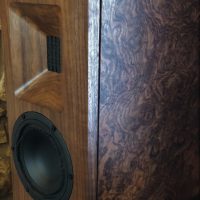
something unique the oneZ's front baffle can be
custom ordered in solid hardwood. The special sonic and visual beauty
of hardwoods add the final flourish to the oneZ while enhancing even
the most sophisticated decor.
Taken as a whole the details used in oneZ emerge upon close examination
to delight the eye yet effortlessly receded back into the whole
never dominating the object's classic style. Function dictates form,
form yields up detail, detail is executed with style which completes
the cycle returning to function.